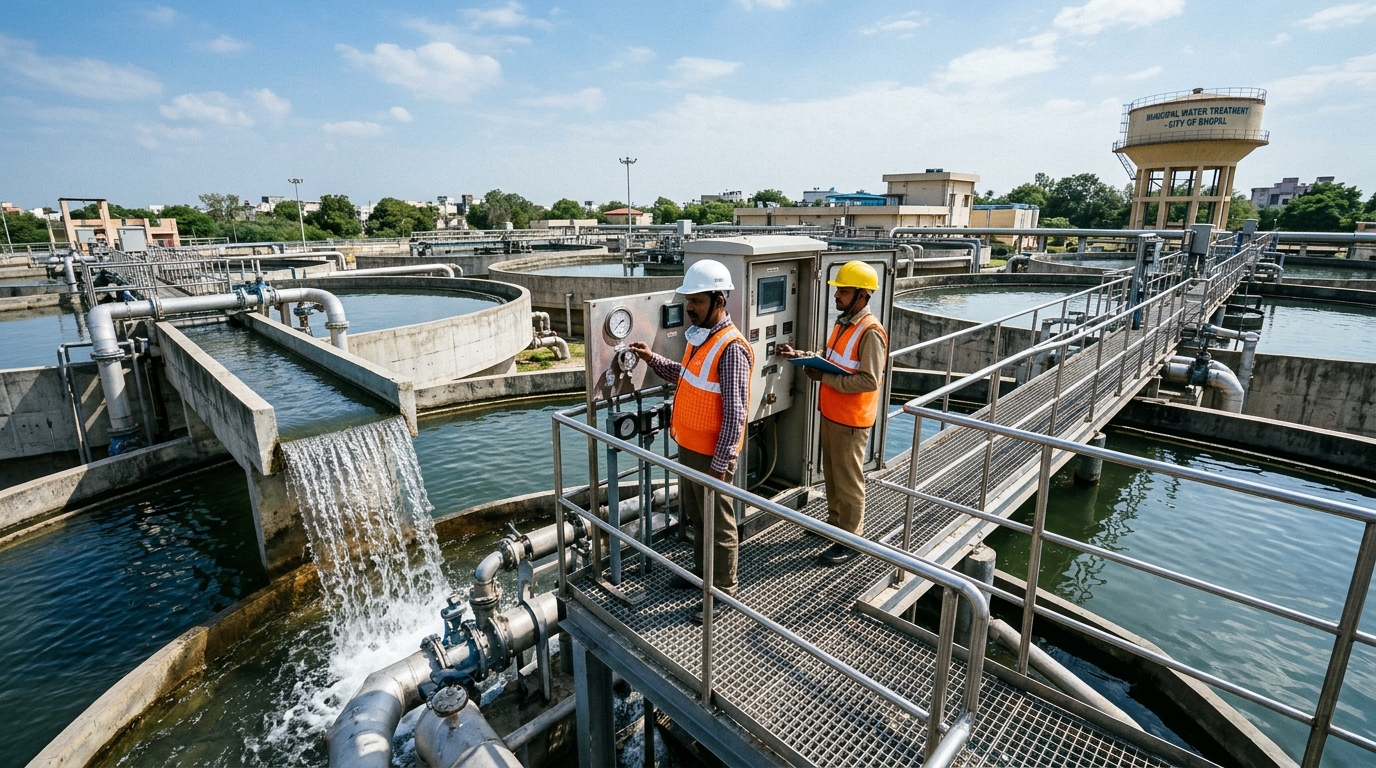
Continuous Sensor Telemetry at Major Pumping Terminals
Supplying over 1,450 million liters of potable water daily across Bengaluru requires transporting treated water from the Cauvery River over a distance of more than ninety kilometers and lifting it through steep elevation gradients.
Historically, water quality testing relied on manual grab samples collected at storage reservoirs and transported to central chemical laboratories for testing—a process that took 24 to 48 hours to yield results.
The newly installed monitoring stations feature optical and electrochemical sensor probes that measure critical chemical and biological indicators—including pH balance, turbidity, residual free chlorine, dissolved solids, and electrical conductivity—transmitting real-time readings every ninety seconds via cellular telemetry to the BWSSB central control room.
India Infrastructure Procurement & Heavy Transit Forum 2026
Connect with leading civil engineering contractors, smart city municipal directors, and regional transport authorities.
Learn More →Automated Alarm Thresholds and Immediate Corrective Dosing
The automated telemetry platform is programmed with stringent statutory drinking water quality thresholds compliant with Bureau of Indian Standards (BIS 10500) parameters.
If residual chlorine falls below the mandated disinfection threshold of 0.2 ppm at any service reservoir node—indicating potential pipeline contamination or pressure loss—the system immediately sounds automated visual alarms and sends alerts to zonal executive engineers.
Simultaneously, computerized chemical dosing pumps at secondary treatment stations automatically adjust chlorine injection rates to maintain continuous microbial safety before water enters household distribution pipes.
Public Dashboard Transparency and Citizen Confidence
As part of its open governance initiative, BWSSB has launched a public digital dashboard and mobile interface that allows city residents to view real-time water quality metrics for their specific municipal ward.
By demonstrating that municipal tap water meets certified purity benchmarks directly at the pipeline delivery point, civic authorities aim to reduce reliance on private bottled water and promote sustainable municipal resource utilization across the tech capital.