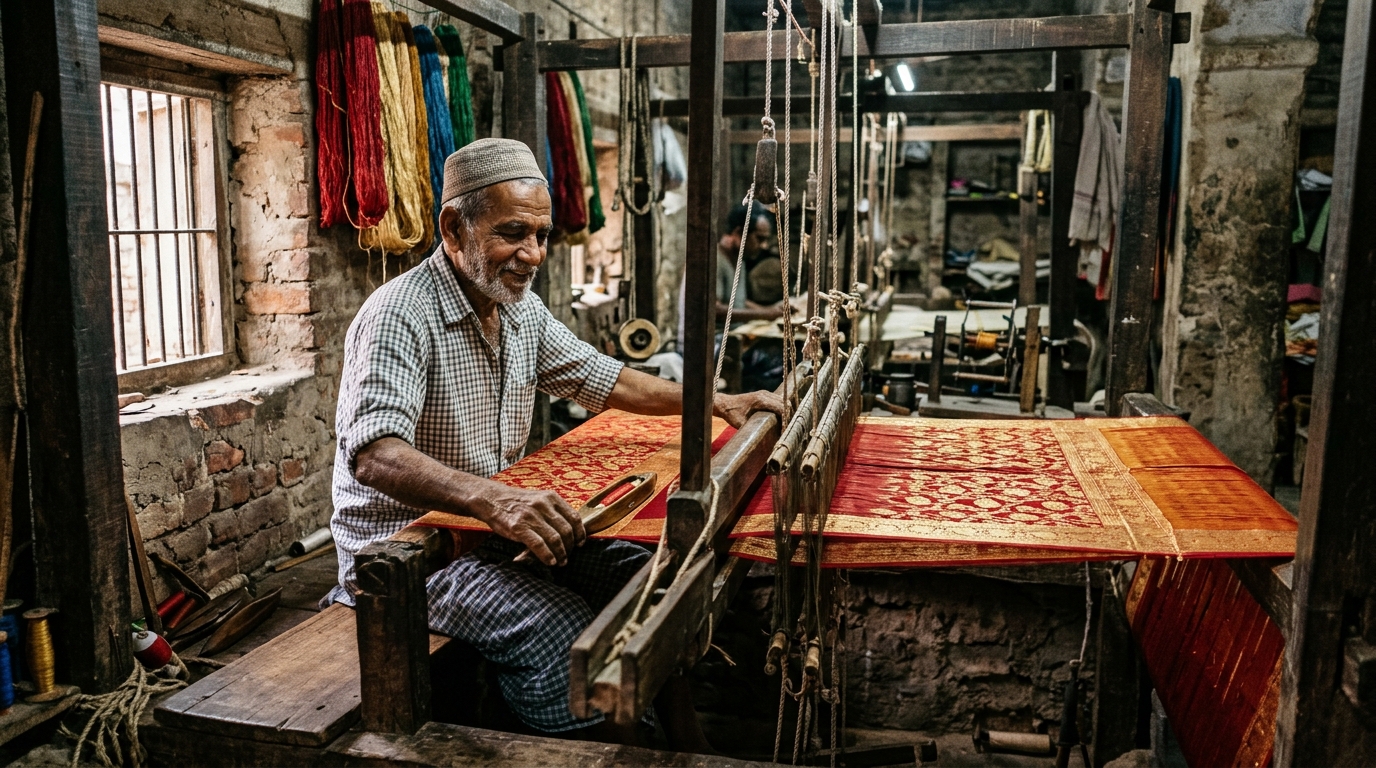
The Artistry of the Jacquard Pit Loom and Zari Weaving
Authentic Banarasi handloom weaving is an extraordinary marriage of geometric precision and artistic patience. A master artisan (known locally as a 'Karigar') collaborates with pattern designers ('Naqshband') who meticulously translate traditional floral motifs, paisleys ('Kalka'), and architectural arches onto perforated graph cards used in Jacquard mechanisms.
Depending on the complexity of the weave—such as the specialized Kadhwa technique where motifs are individually hand-embroidered into the warp without floating threads on the reverse—a single bridal saree can require between three weeks and six months of sustained, skilled manual labor.
The hallmark of genuine Banarasi brocade lies in the quality of raw silk (traditionally sourced from mulberry silkworms) and genuine gold or silver zari wire (muga threads coated with precious metals). When woven on a handloom, the fabric exhibits a characteristic textured drape and luminous depth that mass-manufactured synthetic textiles cannot replicate.
India Infrastructure Procurement & Heavy Transit Forum 2026
Connect with leading civil engineering contractors, smart city municipal directors, and regional transport authorities.
Learn More →Geographical Indication (GI) Enforcement and QR-Enabled Traceability
To counter the influx of cheap, imported synthetic imitations sold deceptively as 'Banarasi Silk', traditional artisan cooperatives secured legal protection under Geographical Indication (GI) Certificate No. 99. The GI registration defines exact spatial and procedural boundaries: only textiles hand-woven in specified districts of eastern Uttar Pradesh adhering to traditional warp-weft specifications may legally carry the Banarasi Handloom trademark.
In recent years, the Office of the Development Commissioner for Handlooms, in partnership with regional weaver societies, has introduced tamper-proof silk mark labels incorporating digital QR codes.
When scanned by a consumer, the QR code retrieves the artisan cooperative registry number, the village of manufacture, the verified purity certificate of the silk and zari, and the exact loom hours invested. This technological traceability provides authentic weavers with a premium pricing shield against counterfeit industrial textiles.
Artisan Welfare and the Weaver Service Centre Initiatives
The preservation of Varanasi's handloom ecosystem depends not merely on historical prestige, but on the economic dignity of younger-generation artisans. The Weaver Service Centre (WSC) in Chowkaghat has established modern training modules that combine traditional loom ergonomics with digital pattern-making software.
Furthermore, direct-to-artisan procurement fairs organized by the Ministry of Textiles and municipal craft councils have eliminated exploitative intermediary traders. Artisans now access subsidized raw silk bank credits and solar-powered lighting systems that allow evening weaving without straining eyesight during seasonal power fluctuations.
As global interest in slow fashion, sustainable natural fibers, and authentic indigenous crafts expands, Varanasi's handloom weavers demonstrate that ancestral heritage and contemporary market integrity can flourish in perfect technical harmony.
“Every thread woven into a genuine Banarasi handloom carries the memory of generations. The Geographical Indication tag is not merely a legal label; it is the constitutional shield that protects our artisans' intellectual heritage from industrial dilution.”
Varieties and Characteristics of Traditional Banarasi Handloom Textiles
| Weaving Technique / Variety | Structural Characteristics | Typical Production Time |
|---|---|---|
| Kadhwa Silk | Motifs individually hand-woven; zero loose floats on reverse | 45 to 120 days on pit loom |
| Jangla Brocade | Dense all-over floral jaal woven in gold and silver zari | 30 to 60 days on pit loom |
| Tanchoi Weave | Satin weave base with multi-colored extra weft silk designs | 20 to 40 days on pit loom |
| Cutwork (Phekwa) | Continuous weft floats cut manually after loom extraction | 14 to 25 days on pit loom |
| Tissue Zari Saree | Metallic zari used as warp and weft for translucent sheen | 30 to 50 days on pit loom |
How to Verify Genuine Banarasi Handloom Silk
- Look for the official Silk Mark Organization of India (SMOI) butterfly hologram stitched to the pallu.
- Inspect the reverse of the motifs: handloom Kadhwa weaves show clean, individual knotting without mechanical frayed edges.
- Scan the official GI-registered QR authentication code to verify artisan cooperative origin and loom registry.
- Observe the natural selvedge edge of the fabric, which displays subtle handloom pin marks characteristic of wooden shuttle tension.