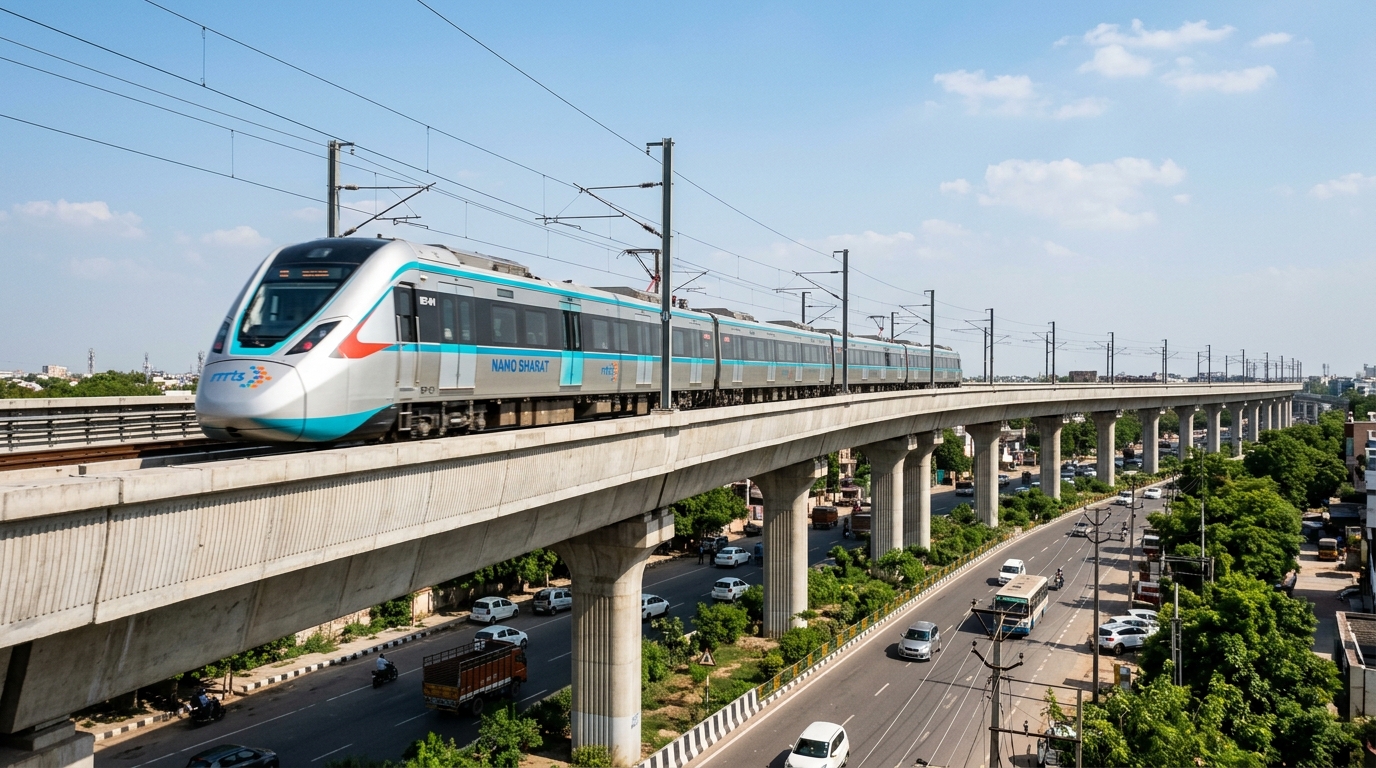
Engineering Architecture and High-Speed Rail Viaducts
Constructed under the aegis of the National Capital Region Transport Corporation (NCRTC)—a joint venture between the Government of India and participating state administrations—the Delhi-Meerut corridor incorporates ballastless track engineering across elevated and underground tunnels. The aerodynamic trainsets feature lightweight stainless steel and aluminium coaches fabricated domestically in Savli, Gujarat.
Equipped with advanced European Train Control System (ETCS) Level 2 signaling over Long Term Evolution (LTE) digital radio telemetry, the trains maintain automatic train protection (ATP) and automatic train operation (ATO) interfaces. This level of automated safety supervision enables commuter headway frequencies of under ten minutes during morning and evening rush hours.
Unlike conventional suburban railway networks that share tracks with heavy freight rakes, the RRTS operates on a dedicated grade-separated corridor. Commuters traveling from Meerut South to Sarai Kale Khan in New Delhi now complete their intercity journey in under fifty-five minutes—a transit contraction of over 65% compared to congested arterial roadways such as the Delhi-Meerut Expressway.
India Infrastructure Procurement & Heavy Transit Forum 2026
Connect with leading civil engineering contractors, smart city municipal directors, and regional transport authorities.
Learn More →Multi-Modal Integration with Delhi Metro and Inter-State Bus Terminals
A foundational design doctrine of the RRTS architecture is multi-modal physical and digital integration. At major interchange nodes, such as Anand Vihar and Sarai Kale Khan, passenger concourses seamlessly converge with Delhi Metro lines, Indian Railways mainline platforms, and inter-state bus terminals (ISBTs).
Pedestrian skywalks equipped with travelators and universal accessibility ramps ensure that commuters transfer between high-speed regional trains and local urban transit without exiting paid security perimeters. Furthermore, the integration of the National Common Mobility Card (NCMC) allows passengers to use a single contactless RuPay transit card across both the Delhi Metro and Namo Bharat systems.
This integration reduces reliance on personal motorized vehicles, removing an estimated 100,000 vehicular passenger trips daily from NCR highways and substantially curbing vehicular emissions across the airshed.
Socio-Economic Decentralization Along the Regional Axis
Beyond physical speed, urban planners highlight the profound decentralizing impact of high-frequency regional rapid transit. Traditionally, economic opportunities and high-value professional services remained heavily concentrated in Central Delhi and southern corporate enclaves. Commuters residing in Meerut, Modinagar, or Muradnagar faced exhausting four-hour daily road commutes.
With reliable sub-one-hour transit, satellite towns are rapidly evolving into sustainable residential and educational centers. Municipal authorities in Ghaziabad and Meerut report increased demand for civic development, including new logistics parks, regional university extensions, and planned housing colonies built under transit-oriented development (TOD) zoning guidelines.
As phase-two corridors connecting Delhi to Alwar via Gurugram and Delhi to Panipat advance through preliminary alignment clearances, the RRTS framework establishes a reproducible national standard for peri-urban mobility across Indian metropolitan regions.
“The Namo Bharat corridor proves that high-speed commuter rail is not a luxury for developing nations; it is the vital civic circulatory system necessary to prevent catastrophic metropolitan paralysis and foster balanced regional economic growth.”
Delhi-Ghaziabad-Meerut RRTS Corridor Technical Specifications
| Technical Feature | Specification / Metric | Civic Impact |
|---|---|---|
| Total Corridor Length | 82.15 Kilometers (68.03 km Elevated, 14.12 km Underground) | Seamless intercity transit connectivity |
| Design Speed / Operational Speed | 180 km/h Design / 160 km/h Operational | Reduces total journey time from 2.5 hrs to 55 mins |
| Signaling & Telemetry | ETCS Level 2 over dedicated LTE network | World-class automatic train protection & high frequency |
| Coaches & Power Supply | 6-Car Aerodynamic trainsets / 25 kV AC Traction | Energy regeneration braking saves up to 30% power |
| Multi-Modal Interchanges | Sarai Kale Khan, Anand Vihar, New Ashok Nagar | Direct physical transfers with Metro, Bus & Rail |
Key Features of Namo Bharat Commuter Services
- Universal step-free platform boarding with full-height Platform Screen Doors (PSDs) synchronized with train doors.
- Dedicated premium coach and reserved seating compartments for female commuters and senior citizens.
- Provision for specialized emergency stretchers and onboard medical response equipment in the rear coach.
- Seamless contactless entry via NCMC cards and dynamic QR-ticketing on the official NCRTC mobile application.