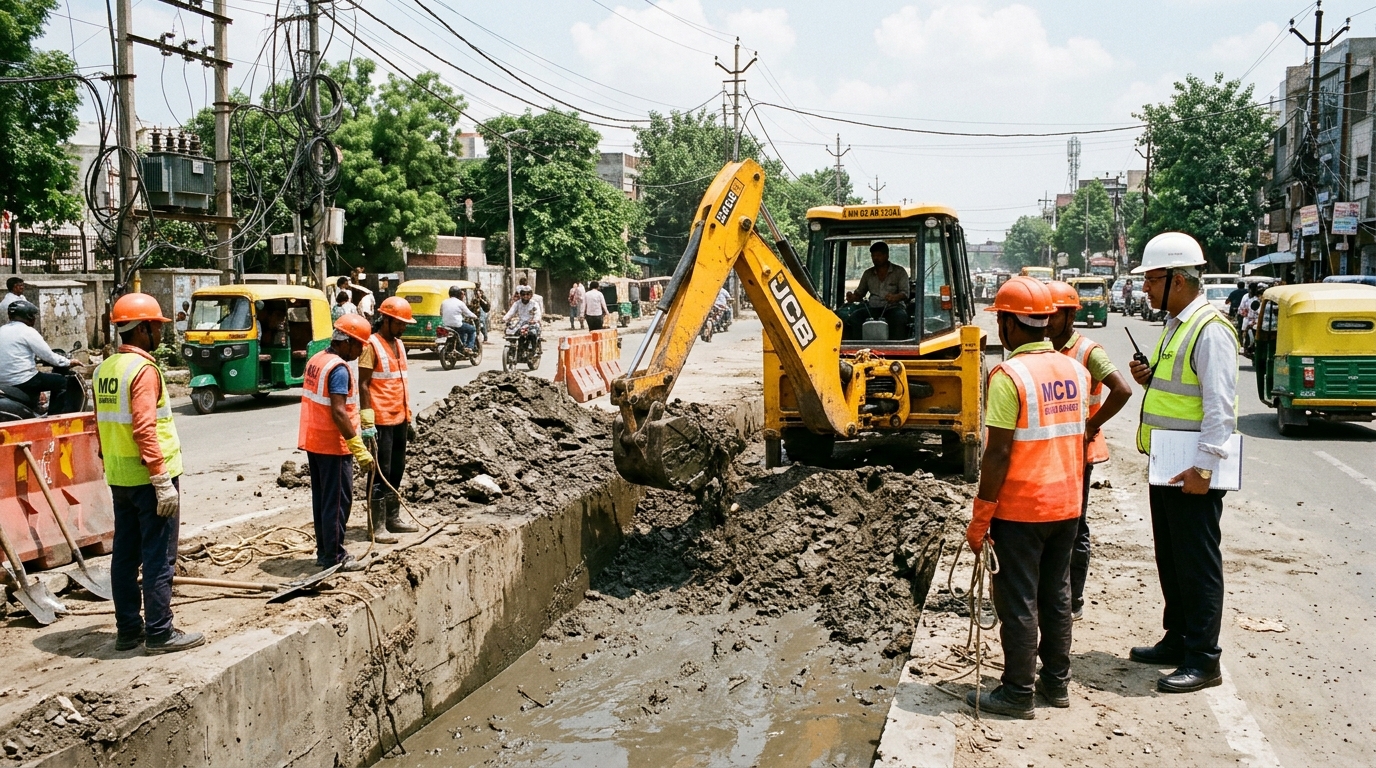
Deployment of High-Capacity Super Sucker Machines
The civic maintenance campaign relies on the deployment of over sixty specialized high-capacity jetting-cum-suction machines, amphibious excavators, and mechanical silt recovery cranes. Historically, manual dredging often left dense silt beds along channel banks, which were washed back into drainage lines during the first heavy rainfall.
Under current operational standard operating procedures (SOPs), extracted municipal sludge is loaded directly into hermetically sealed dumper trucks and transported to designated engineered processing sites at Ghazipur, Okhla, and Narela for drying, volume stabilization, and safe disposal.
India Infrastructure Procurement & Heavy Transit Forum 2026
Connect with leading civil engineering contractors, smart city municipal directors, and regional transport authorities.
Learn More →Digital Drone Surveys and CCTV Silt Bed Mapping
To eliminate blind spots and verify contractor performance, the MCD Engineering Department has introduced aerial drone inspections and submersible CCTV inspection rovers across subterranean covered box drains in high-density commercial corridors such as Chandni Chowk, Connaught Place, and Karol Bagh.
Zonal executive engineers are required to upload geofenced, timestamped 'before-and-after' video logs onto the centralized Municipal Silt Management Portal before certifying contractor milestone invoices.
Furthermore, municipal authorities have coordinated closely with the Public Works Department (PWD) and the Delhi Development Authority (DDA) to ensure that arterial culverts passing beneath major railway tracks and national highways maintain unobstructed hydrological flow.
Civic Engagement and Waste Disposal Advisory
Municipal zonal directors have issued strong advisories to local market welfare associations and residential societies regarding the illegal disposal of plastic packaging, construction debris, and solid waste into open drainage grates.
Specialized silt-trapping screens and interceptor grilles have been installed at key vulnerable intersections to catch floating solid refuse before it reaches primary trunk outfalls leading into the Yamuna basin.
Through these mechanized engineering measures, civic authorities aim to ensure that residential colonies throughout the capital experience rapid runoff drainage and zero prolonged road submergence during high-intensity tropical precipitation events.