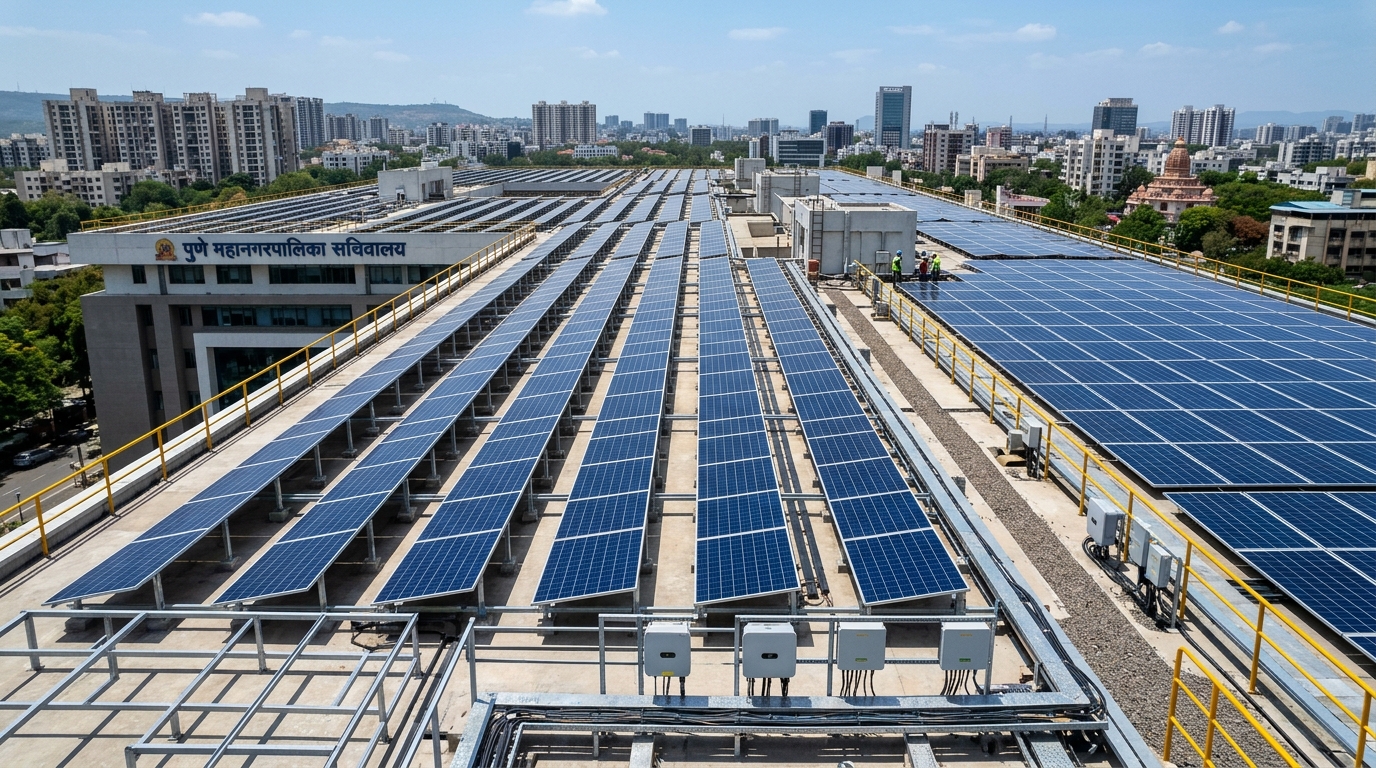
Net Metering Architecture and Bi-Directional Grid Integration
The economic cornerstone of residential rooftop solar adoption is the bi-directional net meter. Under this regulatory framework, photovoltaic arrays installed on private terraces or apartment roofs feed electricity directly into the building's internal distribution panel during daylight hours.
Any surplus power not consumed on-site is automatically exported into the low-tension municipal utility grid, causing the digital net meter to run in reverse. At the close of each billing cycle, distribution companies (DISCOMs)—such as Torrent Power, GUVNL, or MSEDCL—calculate the net energy imported minus the energy exported.
For residential consumers who size their systems to meet average daily consumption, monthly electricity tariffs are routinely reduced by 70% to 90%, leaving consumers responsible primarily for basic fixed meter charges and regulatory electricity duty.
India Infrastructure Procurement & Heavy Transit Forum 2026
Connect with leading civil engineering contractors, smart city municipal directors, and regional transport authorities.
Learn More →Cooperative Housing Societies as Community Micro-Generators
While individual bungalows were early adopters, the current wave of clean power expansion is driven by multi-story Cooperative Housing Societies (CHS). In cities such as Surat, Ahmedabad, Pune, and Thane, societies possess extensive contiguous terrace areas ranging from 5,000 to 20,000 square feet.
Municipal bylaws now allow housing societies to install dedicated common-load solar plants ranging from 20 kW to 100 kW. These communal systems generate sufficient power to energize heavy shared loads, including water lifting pumps, passenger elevators, basement ventilation fans, and common area LED illumination.
By eliminating electricity bills for common utilities, housing societies report substantial reductions in monthly resident maintenance charges, while surplus power credits are distributed proportionally across individual flat owner meters under group net-metering provisions.
Digital Single-Window Clearance and Quality Standardization
Historically, the installation of rooftop solar was hindered by cumbersome administrative paperwork, including lengthy DISCOM approvals, electrical inspectorate clearances, and delayed subsidy disbursements. In response, state energy departments introduced unified digital single-window portals.
Homeowners and housing society secretaries now submit their applications, structural stability certificates, and sanctioned electrical load documents online. DISCOM feasibility assessments are completed within seven working days, followed by automated vendor allocation from empanelled, certified solar EPC contractors.
Rigorous technical standardization enforced by the Bureau of Indian Standards (BIS) and the Ministry of New and Renewable Energy (MNRE) mandates the use of domestically manufactured TOPCon monocrystalline modules and IP65-rated micro-inverters. With system lifespans exceeding twenty-five years and payback periods contracting to four years, Western India's rooftop solar model exemplifies practical, citizen-led energy sustainability.
“Rooftop solar has fundamentally altered the relationship between Indian citizens and the electrical grid. Citizens are no longer passive consumers burdened by rising tariffs; they are active, responsible green power producers contributing to national energy independence.”
Standard Residential Rooftop Solar Capacity, Capital Expenditure & Savings Matrix
| System Capacity | Terrace Area Needed | Average Daily Output | Estimated Monthly Tariff Savings |
|---|---|---|---|
| 3 kW Plant (Bungalow / 2-3 BHK) | 300 sq. ft. unobstructed terrace | 12 to 14 kWh (Units) | ₹2,800 to ₹3,500 monthly |
| 5 kW Plant (Large Residence / Villa) | 500 sq. ft. terrace | 20 to 24 kWh (Units) | ₹4,800 to ₹6,000 monthly |
| 10 kW Plant (Small Society / Duplex) | 1,000 sq. ft. terrace | 40 to 48 kWh (Units) | ₹10,000 to ₹12,500 monthly |
| 30 kW Plant (Medium Housing Society) | 3,000 sq. ft. terrace | 120 to 145 kWh (Units) | ₹32,000 to ₹38,000 monthly |
| 50 kW Plant (Large High-Rise Complex) | 5,000 sq. ft. terrace | 200 to 240 kWh (Units) | ₹55,000 to ₹65,000 monthly |
Procedural Steps to Install Residential Rooftop Solar
- Conduct a shadow and structural terrace survey to verify unobstructed south-facing sun exposure.
- Register on the National Unified Rooftop Solar Portal with your DISCOM consumer number and sanctioned load.
- Select an empanelled, ALMM-compliant solar vendor to ensure entitlement to central capital subsidies.
- Ensure installation of a certified bi-directional digital net meter and surge protection grounding rods.